
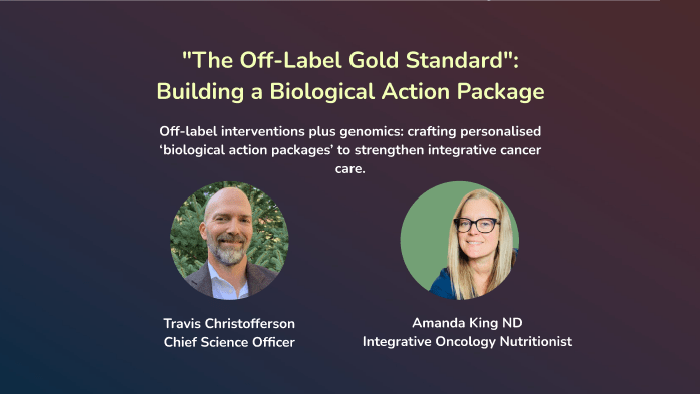
On a deep dive into drug repurposing in cancer care and building a “biological action package”, Travis Christofferson, author of Tripping Over the Truth, and Amanda King, ND, elaborated on adopting a personalised and integrative approach to enhancing cancer treatment outcomes through repurposed drugs and supportive therapies.
Here are the Key Takeaways:
- Drug repurposing leverages the untapped potential of generic, off-patent drugs to target cancer biology in new ways.
- Many of these drugs have well-documented off-target effects that may disrupt cancer pathways when matched correctly.
- Genomic testing can reveal vulnerabilities in a tumour’s molecular profile that are not addressed by standard therapies alone.
- Astron Health’s bioinformatic approach helps prioritise and personalise repurposed drug options based on an individual’s cancer profile.
- When combined with lifestyle interventions, supplements, and clinical guidance, this strategy forms a synergistic care model that goes beyond one-size-fits-all treatment.
As cancer care evolves, so too must our approach to the tools we use. One of the most underutilised yet promising areas in integrative oncology is drug repurposing—using existing, off-patent medications in new ways to complement and enhance standard-of-care treatments.
At Astron Health, we believe that when repurposed therapeutics are combined with genomic insights, lifestyle interventions, and clinician-led care, they form what we call a “Biological Action Package”—a personalised constellation of adjunctive therapies that work together to support better outcomes for patients.
What Are Repurposed Drugs and Why Do They Matter?
Drug repurposing involves finding new uses for medications originally developed for other conditions. Many of these drugs like metformin, mebendazole, or statins have long safety records, are off-patent, and are widely available. But beyond their primary indication, these medications often exhibit “off-target effects” that can interfere with cancer-related pathways.
For example, metformin, a common diabetes medication, has been shown to inhibit the PIK3CA pathway—a known player in treatment resistance in some breast cancers. Though it’s not currently standard-of-care for these cases, early trials suggest it may hold substantial benefit for specific patient subgroups when used strategically.
Why Are Off-Target Effects So Powerful?
Most drugs are what scientists call pleiotropic they act on multiple pathways in the body. This characteristic, once considered a nuisance due to side effects, is now recognised as a therapeutic asset. Many drugs affect not just their intended target, but several cellular pathways, some of which may be directly or indirectly linked to cancer biology.
While these benefits often go unnoticed in conventional settings, they can become powerful tools when we’re able to match a drug’s hidden potential with a patient’s specific molecular profile.
A Problem of Access and Incentive
Despite the promise of drug repurposing, financial disincentives mean most pharmaceutical companies don’t pursue formal approval for new indications of old drugs. Once a patent expires, there’s little financial motivation to fund large-scale trials.
This leaves potentially life-saving therapies in what researchers call “financial purgatory.” Fortunately, academic researchers, nonprofits, and clinicians have stepped in—backed by growing patient demand and a steady stream of promising scientific literature.
Astron Health’s Approach: Precision Drug Repurposing
At Astron Health, we’ve developed a bioinformatic framework to systematically evaluate the 250+ repurposed drugs shown to have anticancer activity. We assess:
- Genomic Vulnerabilities
Using blood or tissue-based genomic reports, we identify the key mutations or pathway dependencies in a patient’s cancer. - Drug Matching
We analyse which repurposed drugs are likely to target those vulnerabilities, based on scientific literature, mechanism of action, and strength of evidence. - Clinical Relevance
We rank options by effectiveness, safety profile, evidence strength, and potential to work synergistically with existing treatments. - Personalised Reporting
All findings are presented in a report designed to support oncologists and clinicians in developing a targeted, evidence-based protocol for the patient.
Why a “Biological Action Package” Matters
No single intervention is likely to be a silver bullet against cancer. However, when multiple therapies—each grounded in solid science—are carefully selected to complement one another, they can produce a synergistic effect far greater than the sum of their parts.
We call this integrative, layered strategy the “Biological Action Package.” It’s not about throwing everything at the wall. It’s about identifying and combining therapies—repurposed drugs, lifestyle interventions, targeted supplements—that are most likely to support your body’s resilience and your treatment plan’s success.
Conclusion: More Than the Sum of Its Parts
As Dr. Donald Boyd of Yale notes, the integrative approach isn’t just additive—it’s transformative. When we embrace the complexity of cancer by tailoring a multidisciplinary protocol to the individual, we unlock new levels of empowerment and efficacy.
At Astron, our goal isn’t just to help people survive cancer. It’s to help them emerge stronger—more informed, more supported, and, in some cases, healthier than when they began.
Explore Astron Health
Astron Health provides personalised research reports to patients through their clinicians. These reports are designed to support decision-making where off-label drugs, supplements, or adjunctive therapies may play a role. If you’re a patient, speak with your oncologist about whether Astron’s insights might benefit your care. If you’re a clinician interested in learning more, please contact us at support@astron.health—we’d love to collaborate.
Astron advances precision oncology through data-driven research, providing specialized reports to patients under oncologist supervision when our insights may benefit treatment decisions. Patients should discuss with their clinician whether an Astron Report could support their care, or we can connect them with qualified oncologists familiar with our platform. Clinicians interested in collaboration opportunities can contact support@astron.health.
 Astron Health Blog
Leave a comment