
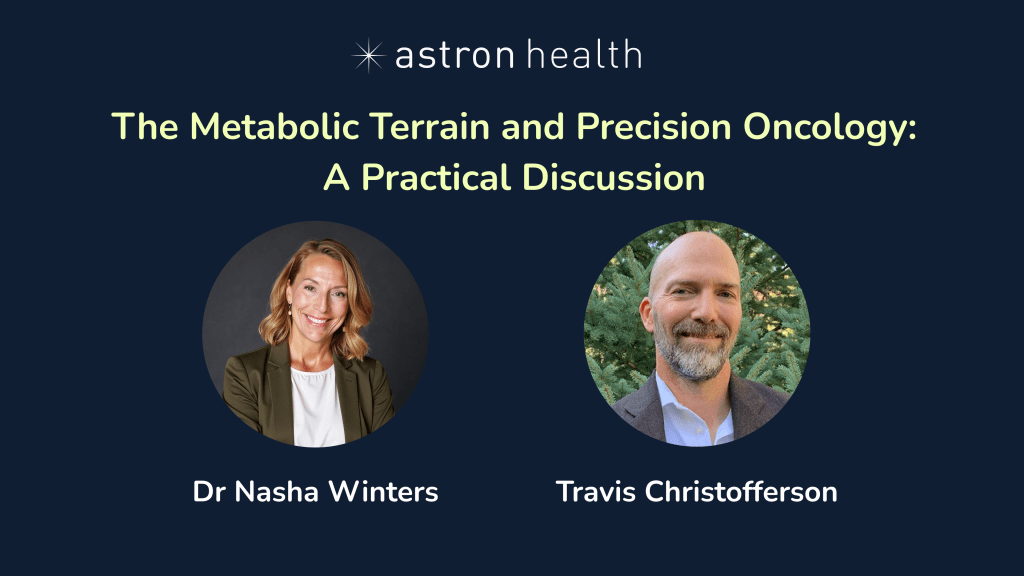
Why terrain and molecular data belong in the same conversation and what that means for patients and clinicians.
Why This Conversation Matters
Cancer treatment has historically focused on the tumour, its type, its stage, its genetic mutations. And over the past two decades, precision oncology has made extraordinary progress in mapping the molecular drivers behind each patient’s cancer.
But there’s a growing recognition that the tumour doesn’t exist in isolation. The biological environment it grows in, what integrative oncologists call the terrain plays a critical role in how cancers develop, progress, and respond to treatment. Factors like inflammation, immune function, metabolic health, hormonal balance, and even circadian rhythm all shape outcomes in ways that are increasingly backed by robust clinical data.
The question isn’t whether the terrain matters. It’s how we act on it in a targeted, evidence-informed way and how we bring it together with the molecular data that precision oncology provides.
That was the focus of our live discussion on April 14th with Dr Nasha Winters, author of The Metabolic Approach to Cancer, and Travis Christofferson, author of Tripping Over the Truth. Over 500 clinicians, patients, and caregivers joined the session. Here’s what we explored.
The Clumsy History of Cancer Science
Travis and Nasha opened by tracing the arc of how we’ve understood cancer over the past century and how much has been lost along the way.
The story starts in 1914 with Theodore Boveri, who proposed that cancer is fundamentally a disease of genetic mutations. A few years later, Otto Warburg challenged that view, arguing that metabolic dysfunction, not genetics, was the upstream driver. Warburg’s work gained traction through the 1950s, but was largely sidelined after the discovery of the DNA double helix shifted the scientific establishment’s focus squarely back to genetics.
The Cancer Genome Atlas project was supposed to deliver definitive answers. Instead, what it revealed was extreme heterogeneity a confusing patchwork of mutations that didn’t fit the neat, linear models researchers expected. That confusion opened the door for scientists and clinicians to start asking different questions, and to revisit the metabolic and environmental factors that Warburg had pointed to decades earlier.
As Nasha put it: genetics matter, but they may be more of a downstream expression than a starting point. The terrain is what determines whether and how those genetic programmes get switched on.
What the Terrain Actually Is
For those unfamiliar with the concept, the terrain refers to the internal biological environment of the body — the conditions that either support or suppress tumour growth.
Nasha has organised this into a framework she calls the Terrain Ten, which covers:
- Epigenetics and genetic expression
- Metabolic drivers — fuel sources, timing, and quality of nutritional inputs
- Toxicant exposure and detoxification capacity
- The microbiome
- Hormonal balance
- Inflammation
- Immune function
- Oxygenation and circulation
- Circadian rhythm and biology
- Stress response and mental-emotional impact
These aren’t abstract concepts. Each of these factors directly influences how a patient responds to treatment. A patient with chronic inflammation, poor oxygenation, or a disrupted microbiome may not respond to even the most precisely targeted therapy — not because the therapy is wrong, but because the body isn’t ready to receive it.
This was one of the most important points from the session: the treatments that precision oncology identifies will only be as effective as the terrain allows them to be.
The Clinical Evidence Behind Terrain Interventions
One of the most striking parts of the discussion was the sheer volume of clinical evidence supporting terrain interventions — evidence that remains largely outside standard oncology practice.
Travis walked through several examples:
Vitamin D and treatment response. A randomised controlled trial in breast cancer showed that patients receiving vitamin D supplementation during neoadjuvant chemotherapy nearly doubled their pathological complete response rate. In non-small cell lung cancer, a study of 214 patients found that those with adequate vitamin D levels while on immunotherapy had overall survival rates nearly double that of the control group.
Timing of treatment administration. Studies have shown that receiving immunotherapy in the morning versus the afternoon can lead to close to a doubling of response rates — likely driven by hormonal and circadian fluctuations throughout the day.
Dietary fibre and the microbiome. Two well-executed studies on dietary fibre intake, which directly impacts the gut microbiome, demonstrated meaningful improvements in response to immune checkpoint inhibitors.
These are not fringe findings. They come from well-designed trials published in peer-reviewed journals. Yet as Travis noted, morning administration of immunotherapy has still not become standard of care.
Where Terrain Meets Molecular Data
This is where the conversation turned to precision oncology and the role Astron plays.
Roughly 85% of cancer patients in the US now receive some form of molecular testing, but only about 7% of the targets identified can be matched with an FDA-approved therapy. Most of that data sits unused in patient portals.
By expanding the lens to include the full pharmacopoeia, repurposed medications, evidence-based supplements, and lifestyle interventions, the proportion of actionable targets rises to 80–85%. That’s what the Polaris Report is designed to do: take a patient’s molecular profile and surface the most well-evidenced treatment options across every available intervention, ranked by an evidence score that accounts for clinical trial data, target importance, binding confidence, and drug approval status.
Travis illustrated the power of this approach with an example involving caffeine. Bioinformatic databases flag caffeine as a compound that interacts with PIK3CA, one of the most commonly mutated genes in cancer. A Swedish study of a thousand women found that ER-positive breast cancer patients on Tamoxifen who consumed the most coffee had a 50% reduction in recurrence. A synthetic lethality database explains why: ER inhibition and PIK3CA inhibition form a powerful combination, which is exactly what Tamoxifen plus caffeine achieves.
Similarly, Travis highlighted a randomised controlled trial of 3,649 patients with high-risk operable breast cancer testing metformin versus placebo. The initial results showed no effect. But when researchers looked at subtypes, HER2-positive women carrying a specific genetic variant saw a 49% increase in disease-free survival. The kind of granular, subtype-level insight that changes outcomes, but only if someone is looking for it.
These are the hidden connections that emerge when you systematically mine the research literature at scale, connections that no individual clinician could realistically surface on their own.
The Polaris Report in Practice
During the session, Sam McKaylin, Astron’s Chief Science Officer, walked attendees through a de-identified Polaris Report for a breast cancer case with a high alteration burden.
He showed how the report identifies the molecular story of a patient’s cancer, in this case, activated growth pathways (mTOR, CDK), survival mechanisms (BCL2, survivin), genomic instability (TP53, BRCA1) and then surfaces the most well-evidenced interventions for each.
Beyond the FDA-approved options like PARP inhibitors for BRCA1-mutated cancers, the report highlighted repurposed drugs like metformin, which in patients with mTOR-altered tumours can engage multiple dysregulated pathways simultaneously. It also surfaced options like sirolimus (rapamycin), caffeine, and supplements like berberine, each scored and ranked so clinicians can prioritise based on evidence strength, target importance, and practical availability.
The goal is to give clinicians a ranked, evidence-scored set of options that they can use to build a treatment protocol tailored to the individual patient, engaging as many of the tumour’s dysregulated pathways as possible, with as few interventions as necessary.
What This Means for Patients and Clinicians
Precision oncology and terrain-based care are not competing philosophies. They’re complementary lenses that, when used together, give clinicians a far more complete picture of what’s driving a patient’s cancer and what can be done about it.
Molecular data tells you what’s happening inside the tumour. Terrain assessment tells you what’s happening inside the patient. The Polaris Report helps clinicians translate molecular data into ranked, evidence-scored treatment options. And terrain-informed practitioners ensure those treatments land in a body that’s ready to receive them.
For patients: if you’ve had molecular testing done, there is almost certainly more actionable information in your results than you’ve been told about. And if you haven’t, it may be worth exploring.
For clinicians: whether you work in conventional oncology, integrative medicine, or both the Polaris Report is designed to surface the evidence you need to make more confident, more personalised treatment decisions for your patients.
If you’re a patient or clinician interested in learning more about how the Polaris Report can support your care or practice, visit astron.health.
To learn more about the Polaris Report or to schedule a call with our team click the button below.


Leave a Reply